
🎭 The Shocking Truth About Fake AI Jobseekers: Are You Hiring a Human or a Deepfake?
🤯“What if your newest hire… doesn’t exist?”
Have you ever had a Zoom interview where something felt a little too perfect? No hesitations, no filler words, and somehow… no soul?
Now ask yourself this: What if that candidate wasn’t a person at all?
Is this something you want to search the entire internet for, analyze it, and separate it from everyone else?
After analyzing everything across the internet and gathering real-world insights, the Bhussan.com team shares this friendly, helpful article—because this topic? It’s creepy, real, and closer than you think.
🧩What Are Fake AI Jobseekers (And Why Are They So Dangerous)?
Let’s break it down simply. A fake AI job seeker is someone who uses a mix of:
-
Generative AI tools like ChatGPT to answer questions
-
Deepfake software to manipulate their face and voice during video calls
-
Stolen or synthetic resumes, built to match job descriptions flawlessly
These scammers might never intend to work. Some are cybercriminals, looking to gain access to your internal systems. Others are part of state-backed espionage. In both cases, the risks are not theoretical.
👀 Real-Life Example: The “Weird” Candidate
Dawid Moczadlo, the co-founder of Vidoc Security, shared his experience where a jobseeker wouldn’t raise their hand to their face when asked during a Zoom call. Turns out, the person was likely a deepfake avatar. Creepy, right?
“This is the second time in two months,” Moczadlo said.
“Either you change your hiring process, or learn the hard way.”
💡How Deepfake Jobseekers Are Fooling Real Companies
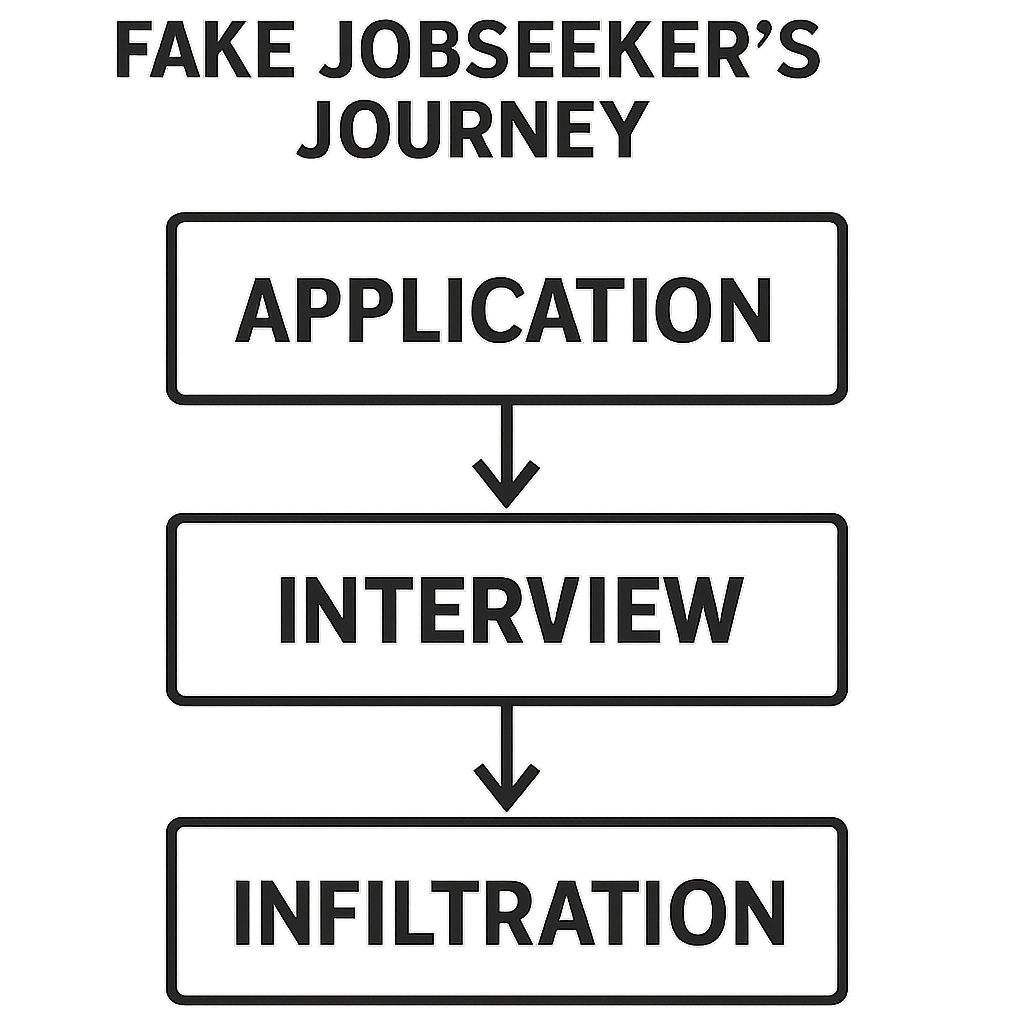
Let’s get a bit more technical (but don’t worry—we’ll keep it human).
🛠️ The Tools They’re Using:
-
DeepFaceLive, FaceSwap, and Synthesia: For live facial overlays
-
Voice.ai and Resemble.ai: For real-time voice modulation
-
ChatGPT and Claude: To respond to technical interviews in “AI-perfect” bullet points
-
Fake portfolios and stolen GitHub activity: To pass resume screenings
Some fraudsters are even outsourcing the actual job after they get hired, earning while someone else does the work. Talk about twisted outsourcing.
😨 But What’s the End Game?
-
Stealing sensitive company data
-
Injecting ransomware
-
Gaining insider access to trade secrets
-
Laundering money through fake payrolls
🧠How to Spot a Deepfake in a Job Interview
Here’s where things get juicy—and practical.
🔍 Red Flags You Should Watch For:
-
Unnatural blinking or smooth facial textures
-
Lagging gestures or refusal to perform real-time verification gestures
-
Bullet-point, overly structured answers
-
No authentic conversation or storytelling
-
No online footprint—LinkedIn is brand-new or oddly empty
🔑 Pro Tip: Ask them to hold up an ID live on camera—then ask for a simple face gesture, like a hand wave or cheek tap. Most deepfake systems can’t simulate both motion and overlay at once.
[Image Suggestion: Side-by-side of a real vs fake candidate gesture detection]
⚔️ How to Protect Your Company from Fake Candidates
Don’t panic—prepare. Here’s how:
✅ 1. Mix In-Person & Remote
Hybrid interviews reveal a lot. AI can’t fake the physical world… yet.
✅ 2. Use AI to Detect AI
Platforms like Microsoft Teams, Zoom Enterprise, and HireVue now include deepfake detection layers.
✅ 3. Behavioral Interviews > Technical
Ask:
-
“What’s a time you failed at something?”
-
“What’s something you regret about your last job?”
You’ll know immediately if a human’s on the other side.
✅ 4. Request Live Verifications
Use tools like:
-
ID.me
-
Jumio
-
TrueID
📊 Pros & Cons of AI in Hiring (Yes, There Are Good Sides Too)
| Pros | Cons |
|---|---|
| Faster screening of resumes using AI tools | Deepfake jobseekers bypass filters easily |
| Can identify genuine skillsets with automated testing | Voice/face spoofing is becoming indistinguishable |
| Cost-effective remote interviews | Trust barrier is rising |
| Greater inclusivity via online interviews | Catfishing and fraud risks are increasing |
🏁 Conclusion: Real Companies Tricked by Fake AI Jobseekers
Let’s not sugarcoat it—AI isn’t coming for your hiring process. It’s already here.
If you’re not verifying candidates properly, asking deeper questions, or using detection tools, you’re leaving the door wide open for a deepfake to walk right in.
But there’s good news: the solutions exist. You just need to apply them.
So, next time you hop on a Zoom call with a jobseeker, ask yourself—who’s really on the other side of the screen?
BrightHire, Vidoc Security, and Pindrop have all reported interviews with fake AI jobseekers in 2025.
In one case, an applicant used a deepfake face and another person to show up after being hired.
If they can fool cybersecurity experts, they can fool anyone.
External Resource Links (With Placement Suggestions):
1. Gartner Research on Fake Candidates
📌 Placement Suggestion: After mentioning “Gartner predicts 25% of candidates will be fake by 2028.”
🔗 Gartner: 25% of job applicants will be fake by 2028
2. CNBC Article on AI Hiring Fraud (BrightHire + Pindrop Cases)
📌 Placement Suggestion: In the section where you mention BrightHire CEO or Pindrop’s CEO.
🔗 CNBC: AI job candidates using deepfakes to land roles
3. LinkedIn Post from Vidoc Security Co-Founder (Dawid Moczadlo)
📌 Placement Suggestion: Right after you describe the “weird” avatar incident during the Zoom interview.
🔗 LinkedIn: Dawid Moczadlo on Fake AI Interview Incident
4. U.S. DOJ Advisory on Deepfake Hiring Scams
📌 Placement Suggestion: In your legal risks or compliance section.
🔗 DOJ: Warning on Deepfake Employment Fraud
5. NIST Research on Deepfake Detection Tools
📌 Placement Suggestion: In the “Tools to Detect Fake Candidates” section.
🔗 NIST: Research on AI Deepfake Detection
🎯 Call-To-Action:
Have you encountered a fake jobseeker or noticed something off during interviews? Share your experience in the comments—or better yet, send this guide to your HR team before your next hire.
Frequently Asked Questions (FAQs) About Fake AI Jobseekers❓
🔎 General Understanding
-
What are Fake AI Jobseekers?
Fake AI Jobseekers are individuals who use artificial intelligence tools—like deepfake software, ChatGPT, and voice modulators—to fake their identity and get hired under pretenses. -
Why would someone use AI to fake a job interview?
To gain access to company systems, steal data, or commit cyber fraud without being physically present. -
How are Fake AI Jobseekers different from traditional resume fraud?
Traditional fraud might involve exaggeration. AI jobseekers simulate entirely fake humans using real-time audio-visual manipulation. -
Are Fake AI Jobseekers illegal?
Yes. They typically violate laws related to identity fraud, cybersecurity, and misrepresentation. -
Is this happening only in tech jobs?
While tech is targeted the most, fake candidates are appearing in remote customer service, marketing, and even finance roles.
💻 Tools & Techniques Used
-
What software do Fake AI Jobseekers use?
Popular tools include DeepFaceLive, Synthesia, ChatGPT, Voice.ai, and Zoom overlays. -
How do they fake their face in a live call?
Using real-time facial mapping, they overlay AI-generated avatars that blink, smile, and even react with subtle expressions. -
Can AI fake voices, too?
Yes, voice modulation software can replicate accents, tone, and even emotions. -
Are there AI-generated resumes too?
Absolutely. Some use ChatGPT to create “perfect match” resumes for job descriptions, making them appear highly qualified. -
Can two people share one fake jobseeker identity?
Yes. Sometimes one person interviews using the deepfake avatar, and another completes the actual tasks post-hiring.
🚨 Detection & Prevention
-
How can I detect a Fake AI Jobseeker in an interview?
Look for:
-
Unnatural facial movements
-
No real-time hand gestures
-
Lag in facial syncing
-
Scripted responses
-
What are real-time liveness checks?
These are verification methods where candidates are asked to perform spontaneous actions (like touching their nose or blinking twice) during live interviews. -
Which platforms offer deepfake detection?
Tools like Microsoft Teams Premium, HireVue, and Zoom Enterprise Security are integrating AI-detection layers in 2025. -
Should I ask for ID during the interview?
Yes. Ask for a live presentation of government ID and cross-verify with a facial gesture. -
Can AI detect other AI?
Yes! There are now software tools that specialize in detecting synthetic speech, faces, and writing patterns.
🛡️ Security & Risk
-
What are the risks of hiring a Fake AI Jobseeker?
-
Malware installation
-
Intellectual property theft
-
Payroll fraud
-
Insider trading leaks
-
HR reputation damage
-
What if a Fake AI Jobseeker gets access to sensitive data?
You may face financial loss, legal liability, and data breach penalties under GDPR, HIPAA, etc. -
Are companies liable for hiring a fake identity?
Yes, especially if data loss or system compromise occurs due to negligence. -
How do HR teams stay safe from this threat?
By using multi-factor identity verification, training hiring managers, and conducting hybrid or in-person follow-ups. -
Can this happen even with reference checks?
Yes, because references can be faked using AI voice cloning or fake LinkedIn networks.
🧠 AI & HR Best Practices
-
Should I stop hiring remotely to avoid fake candidates?
Not necessarily. Just update your verification practices to meet new digital threats. -
Can I use AI to verify a candidate’s online footprint?
Yes. Some tools can analyze consistency across GitHub, LinkedIn, and portfolio sites. -
What should my job description include to discourage AI fraud?
Add a notice: “We use liveness and ID checks during our interview process.” -
Can technical questions still be faked with AI?
Yes. AI tools can answer most coding, logic, or scenario-based questions if they’re not personalized. -
How do I structure interviews to expose AI answers?
Ask reflective or emotion-based questions like:
-
“What work experience changed you most?”
-
“What frustrated you at your last job?”
🔐 Future Trends & Preparation
-
Will this problem get worse in the future?
Yes. Gartner predicts 1 in 4 candidates will be fake by 2028. -
Is there government regulation coming for AI in hiring?
Laws are being proposed in the U.S., EU, and India to regulate AI identity fraud. -
Should all interviews now include face verification?
For remote hiring: yes. Face + voice verification will become the new standard. -
Is AI-generated fraud limited to hiring?
No—it’s spreading into education, banking, and healthcare too. -
Where can I report a suspicious fake job candidate?
Contact:
-
Local cybercrime police
-
CERT-In (India)
-
CISA (USA)
-
Anti-fraud departments of job boards like LinkedIn or Indeed
-
How do I train my team to detect Fake AI Jobseekers?
Run internal workshops using case studies, visual detection training, and roleplay exercises. -
Can video recordings be analyzed post-interview?
Yes. Use forensic tools to analyze anomalies in facial behavior and audio sync.