
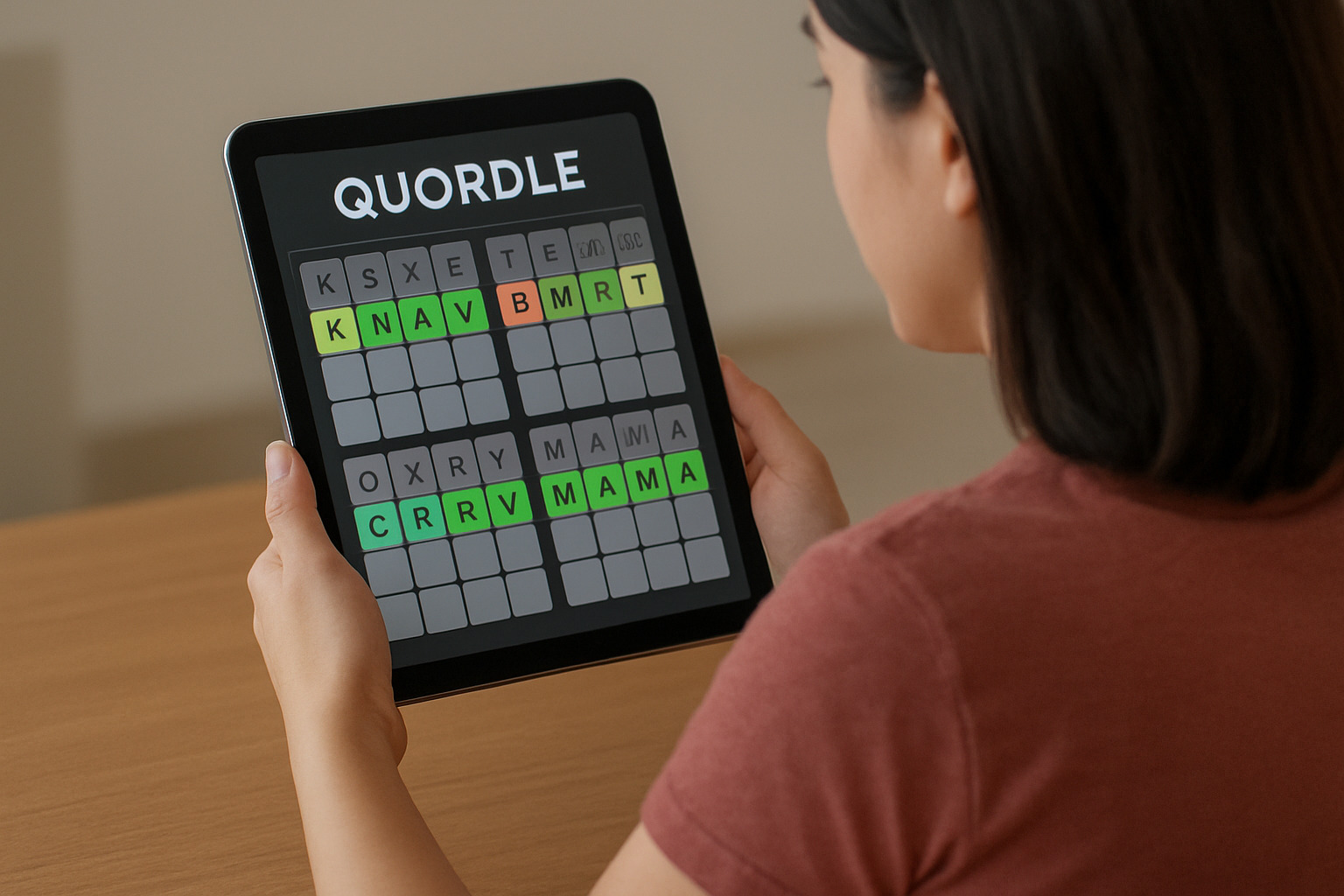
🧩 Cracking Quordle #1303: A Deep Dive into Today’s Puzzle
🎯 Introduction: Why This Puzzle Was Special
Have you ever stared at your Quordle grid and thought, “How on earth am I supposed to solve four words at once?” If yes, you’re not alone. Quordle has become that daily brain teaser millions can’t skip—like your morning coffee or evening scroll through social media. But some days hit harder than others, and Quordle #1303 (August 19, 2025) was one of those days.
After analyzing everything across the internet and gathering real-world insights, the Bhussan.com team put together this friendly, research-backed guide. We’re going beyond just giving you the answers. Instead, we’ll break down each word, explain strategies, share pitfalls to avoid, and even answer the most burning community FAQs.
So grab your mental notepad, because we’re about to crack open KNAVE, SMART, CARRY, and MAMMA—and I promise, by the end, you’ll look at Quordle in a whole new way.
🧠 Word 1: KNAVE — Old English Mischief
Let’s be real: “KNAVE” isn’t a word you use in daily conversation. When did you last call someone a knave? Maybe in a Shakespeare play or a medieval story? That’s exactly why this word tripped so many players.
Historically, “knave” meant a young boy or servant, but over the centuries, it morphed into an insult, calling someone a dishonest scoundrel. Today, its only surviving fame is in a deck of cards, where the Jack is still sometimes labeled as “Knave.”
In gameplay terms, the K—A—E pattern confuses players because there are so few possibilities. You may think of “KNAVE” only if you already suspect an oddball word. This makes it a clever choice for the puzzle designer: obscure enough to slow you down, but not impossible to guess.
👉 Strategy takeaway: Always keep rare letters like K or V in mind. They’re not as common as S, R, or T, but when they appear, they’re usually critical.
💡 Word 2: SMART — Everyday and Everywhere
Now compare “KNAVE” with “SMART.” This word feels like a breath of fresh air in contrast. It’s modern, flexible, and something you probably use several times a day. “Smart” can mean intelligent, stylish, or even painful (like “that cut smarts”).
Why include such an easy word? Puzzle balance. If Quordle only served obscure words, most players would give up. By mixing familiar and rare terms, the game creates rhythm: relief after frustration.
From a solving perspective, “SMART” often pops up quickly because the letters S, M, A, R, T are common opener picks. If you used a strong starting trio like CRANE + DOILY + STUMP, you probably revealed most of this word early.
👉 Strategy takeaway: Common words are not “gimmes.” They give you momentum and free up guesses for tougher boards.
[Image Suggestion: A sleek smartwatch labeled “SMART” on the screen]
📦 Word 3: CARRY — The Double-Letter Trap
At first glance, “CARRY” seems basic. But word games turn “basic” into “brutal” with repeated letters. Most players don’t guess double letters until late. That’s why puzzles like this are sneaky.
Think about it: you may have tried “CARDS” or “CARVE,” only to fail because the second “R” wasn’t tested. The truth is, Quordle designers love throwing in doubles because they slow down even experienced solvers.
In real life, “carry” is such a versatile verb—it means to hold, transport, or even “carry” responsibility. The everyday familiarity contrasts with its in-game difficulty, reminding us how tricky simple words can be when letters repeat.
👉 Strategy takeaway: After your first few guesses, always ask: “Could this word need a double letter?” If yes, test it before running out of attempts.
[Image Suggestion: Person carrying a heavy box, with focus on the word “CARRY”]
👩👧 Word 4: MAMMA — Familiar but Deceptive
Finally, “MAMMA.” You’d think this would be easy—it’s one of the first words babies say. But again, spelling tricks us. Do you write it as Mama, Momma, or Mamma? Quordle picked the version with double M + double A, making it harder than expected.
It’s a word wrapped in tenderness, yet in a puzzle, it’s a mental minefield. Repeated letters eat up guesses, and players often hesitate to test “soft” family words. But here it was—sitting in plain sight, waiting to be solved.
👉 Strategy takeaway: Don’t overlook emotional or everyday words. Sometimes the simplest part of language hides the hardest challenge.
[Image Suggestion: A child hugging their mother with the word “MAMMA” highlighted]
⚖️ Pros and Cons of Today’s Puzzle
| Pros ✅ | Cons ❌ |
|---|---|
| Balanced mix of old and modern words | “KNAVE” felt too archaic for casual players |
| Great practice with double letters | Two double-letter words in one puzzle were tricky |
| Good learning for rare letters (K, V) | High frustration potential for new players |
| Satisfying once solved | Risk of running out of guesses fast |
📊 Strategy Insights from Quordle #1303
-
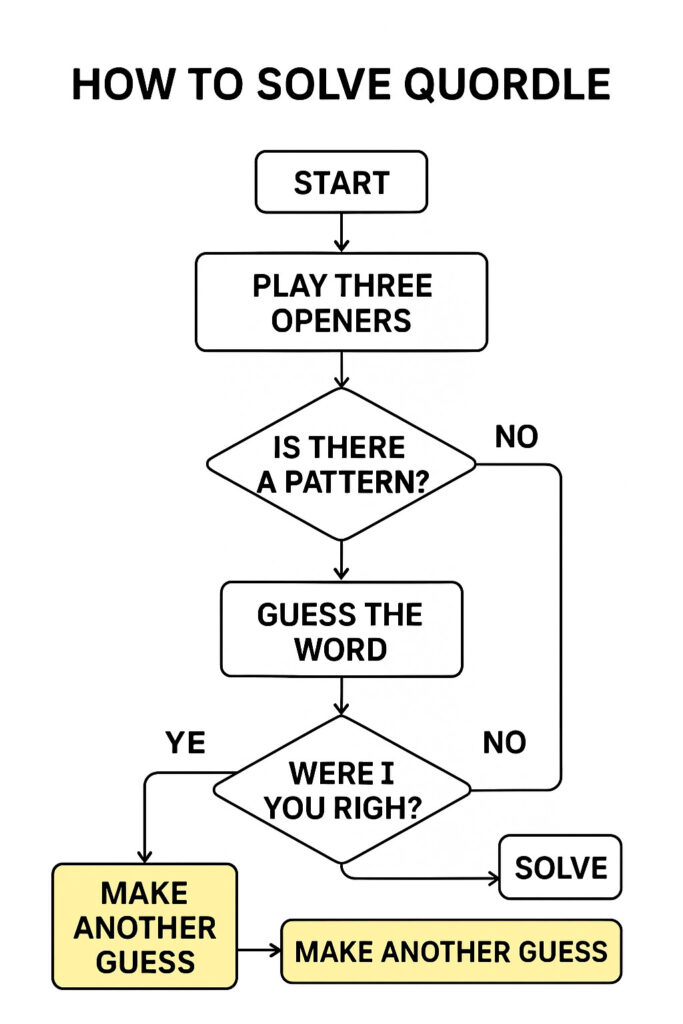
Use multi-word openers (e.g., CRANE, DOILY, STUMP).
-
Expect at least one double letter daily.
-
Watch for rare letters (K, V, J, Q) as puzzle designers love surprises.
-
Balance your guesses: secure easy words first, then save guesses for harder grids.
❓ FAQs
Q1: What were the answers for Quordle #1303 (Aug 19, 2025)?
A: KNAVE, SMART, CARRY, MAMMA.
Q2: What is the hardest word today?
A: KNAVE, because it’s archaic and rarely used.
Q3: Why does Quordle include rare words?
A: To balance difficulty and keep players engaged.
Q4: How often do double letters appear in Quordle?
A: Almost daily—at least one board often contains a double.
Q5: Which strategy works best for Quordle?
A: Multi-word openers covering 12–15 letters early.
Q6: Why was “MAMMA” accepted but not “MOMMA”?
A: Word lists vary; Quordle uses one standardized dictionary.
Q7: What is the average success rate for Quordle players?
A: Less than Wordle—because four words in nine tries is tougher.
Q8: Does Quordle reset at the same time daily?
A: Yes, at midnight local time.
Q9: Can I play past Quordles?
A: Yes, via Quordle’s archive or mirror sites.
Q10: Is “KNAVE” still used today?
A: Rarely—mostly in literature, history, or card games.
Q11: Which word was the easiest today?
A: SMART.
Q12: How many letters were repeated in this puzzle?
A: Two words had repeats (CARRY, MAMMA).
Q13: How to improve at Quordle quickly?
A: Track patterns, practice with doubles, and learn rare 5-letter words.
Q14: Is Quordle harder than Octordle?
A: Octordle is harder (8 words), but Quordle is more balanced for daily play.
Q15: Why do players love Quordle?
A: It blends frustration and satisfaction—the “aha!” moment is addictive.
🏁 Conclusion: Lessons from Puzzle #1303
Quordle #1303 was a rollercoaster: KNAVE tested your history knowledge, SMART rewarded common sense, CARRY drilled home the double-letter lesson, and MAMMA showed how tender words can still trip you up.
If you struggled, don’t worry—you’re not alone. Each puzzle is less about winning and more about sharpening your brain, learning new words, and enjoying the daily ritual.
👉 Ready for tomorrow’s challenge? Bookmark this page and check back, because we’ll keep breaking down every Quordle puzzle—one day, one grid, one smart guess at a time.