
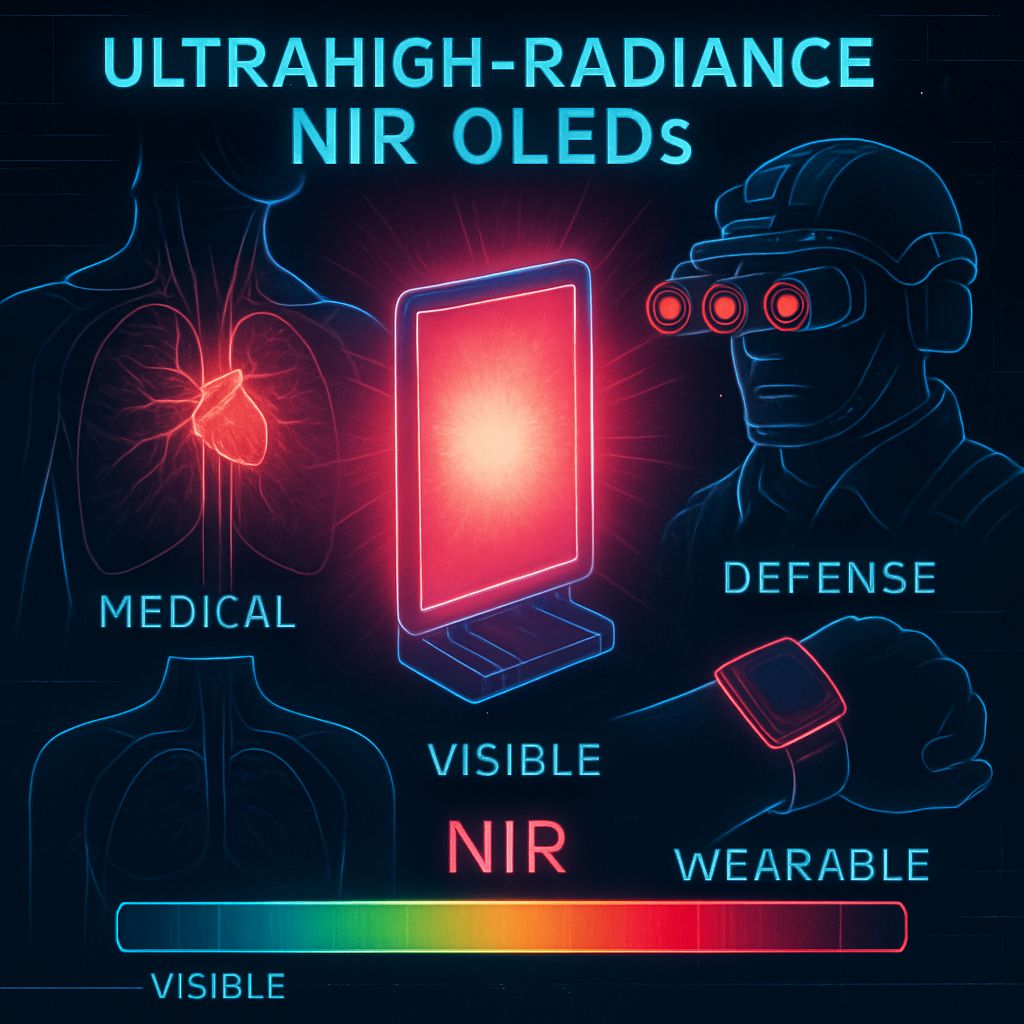
The Organic Infrared Revolution: Why Ultrahigh-Radiance NIR OLEDs Are Lighting Up the Future✨
Have you ever wondered what makes cutting-edge night vision goggles work, or how doctors can peer deep into your tissues without invasive tools? It’s all thanks to one miracle technology: near-infrared light. But here’s the twist… It’s not just about generating NIR light anymore. The race now is to do it efficiently, powerfully, and organically. Intrigued? You should be!
Is this something you’d want to search the entire internet for, analyze it, and separate it from everyone else? No need—after analyzing everything online and gathering real-world insights, the Bhussan.com team shares this friendly, helpful article.
What Are Ultrahigh-Radiance NIR OLEDs?
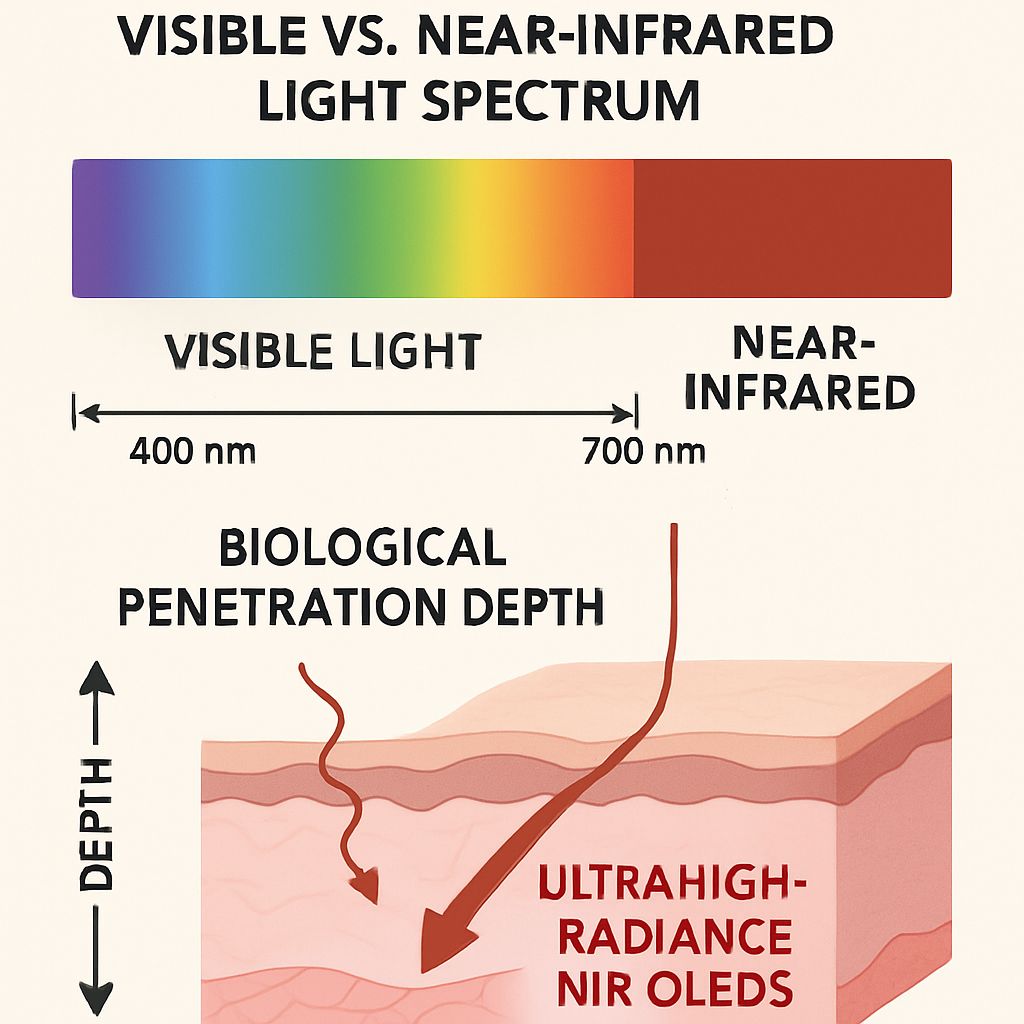
Let’s break it down like we’re chatting over coffee.
-
NIR (Near-Infrared) light lies just beyond visible red light, typically in the range of 700–900 nm. It’s not visible to your eyes, but it can go deeper into biological tissues.
-
OLEDs (Organic Light-Emitting Diodes) use organic (carbon-based) materials to emit light when electricity flows through them.
-
Combine the two, and you get NIR OLEDs that are capable of emitting near-infrared light using organic materials.
What makes ultrahigh-radiance NIR OLEDs different?
They’re like the sports cars of the NIR world: faster, stronger, more efficient. With radiance values hitting over 46,000 W·sr⁻¹·m⁻², these aren’t your average lab toys anymore—they’re high-performance workhorses ready for real-world deployment.
Why Are They So Groundbreaking?⚡

These OLEDs solve a critical challenge that has haunted NIR devices for years: efficiency and longevity. Most NIR OLEDs suffer from something called efficiency roll-off when operated at high currents. That means the harder you push them, the worse they perform. Annoying, right?
But the new design, based on an Acceptor–Donor–Acceptor (A-D-A) structure, changes the game. This clever molecular setup:
-
Reduces triplet lifetime, so unwanted energy losses happen less
-
Suppresses singlet-triplet annihilation, a major culprit behind inefficiency
-
Delivers ultra-high singlet density, which is critical for achieving laser-like performance
The result? You get stable, high-output NIR light, even at current densities of 5,000 A·cm⁻².
Performance That Shocked the Industry📈

Here’s where it gets jaw-dropping. Check out these numbers:
-
Radiance (Pulsed): 46,700 W·sr⁻¹·m⁻²
-
Radiance (Continuous): >2,000 W·sr⁻¹·m⁻²
-
EQE Peak: 1.34%, maintained over 6 orders of magnitude of current density
-
Half-life: 35 hours at 100 W·sr⁻¹·m⁻²
-
J50 (Roll-off Point): 59.2 A·cm⁻² (a major improvement!)
In short, these aren’t lab-restricted materials anymore. They’re commercially viable, reliable, and scalable.
Real-World Uses: From Hospitals to Helmets🚀
So, where do these tiny powerhouses shine? Quite literally, in many places:
-
⚕️ Biomedical Imaging: NIR OLEDs penetrate tissue without harmful radiation. Think: wearable scanners, continuous glucose monitors, even cancer diagnostics.
-
🕵️♂️ Night Vision: Used in military and surveillance for passive, eye-safe vision in low-light environments.
-
🎓 Scientific Instruments: Spectroscopy tools use NIR OLEDs for precise chemical analysis.
-
🌟 Phototherapy & Wearables: Flexible OLEDs enable treatment for acne, pain relief, and wound healing.
What Are the Limitations?❌
Let’s be real. No tech is perfect. Some current hurdles include:
-
Cost of organic synthesis for the A-D-A molecules
-
Material stability under environmental exposure
-
Manufacturing scalability for flexible or wearable formats
But the good news? Researchers are already tackling these with better encapsulation, roll-to-roll printing, and hybrid device integration.
The Future: Are Organic Lasers Coming?✨
Here’s the nerdy-but-awesome part: at high singlet densities (>10¹⁶ cm⁻³), these OLEDs might even enable population inversion.
That’s right—we’re talking about organic laser diodes, powered by electricity. Until now, this has been a major “no-go” area in materials science. But ultrahigh-radiance NIR OLEDs are cracking open the door.
If successful, we could see:
-
Flexible organic lasers for skin therapy
-
Tiny laser sensors in smartwatches
-
Integrated laser displays on wearable AR devices
Pros and Cons📄
| Pros | Cons |
|---|---|
| High Radiance (>46,000 W/sr/m²) | Organic material degradation |
| Low EQE roll-off at high currents | Cost of molecular synthesis |
| Potential for organic lasers | Limited availability of emitters |
| Flexible and wearable formats | Scalability issues |
Ultrahigh-Radiance NIR OLEDs – 30+ FAQs
-
What are Ultrahigh-Radiance NIR OLEDs?
They are organic light-emitting diodes that emit intense near-infrared light with exceptional efficiency and brightness. -
Why is NIR light important in technology?
NIR light penetrates tissue, fog, and darkness, making it useful in medical imaging, night vision, and sensing. -
What does “ultrahigh-radiance” mean?
It refers to very high light output per unit area and solid angle—ideal for applications requiring powerful illumination. -
How do NIR OLEDs work?
They use organic molecules that emit NIR photons when excited by electrical current, similar to visible OLEDs. -
What’s the typical wavelength range of NIR OLEDs?
Usually between 700–900 nm, sometimes extending to 1000 nm for specific applications. -
What makes these OLEDs different from regular ones?
They emit invisible NIR light instead of visible light, and are optimized for efficiency at high current densities. -
What is the ADA (Acceptor–Donor–Acceptor) molecular structure?
It’s a design that optimizes charge transfer and minimizes energy loss, key for efficient NIR light emission. -
Why is singlet–triplet annihilation a problem?
It reduces device efficiency at high brightness; this new OLED design suppresses that issue. -
What is J50 in OLED performance?
It’s the current density where the external quantum efficiency (EQE) drops to 50% of its peak—lower is better. -
How long do NIR OLEDs last?
The latest versions can last over 35 hours at 100 W·sr⁻¹·m⁻²—impressive for this type of high-output device. -
Can NIR OLEDs be used for laser diodes?
Yes, they achieve singlet densities high enough to potentially support population inversion needed for lasing. -
Are NIR OLEDs flexible?
Yes, they can be printed on flexible substrates, ideal for wearables and conformal surfaces. -
How efficient are they compared to traditional LEDs?
Their EQE can remain stable across very high current densities, outperforming many NIR LEDs at scale. -
What are typical applications for these OLEDs?
Biomedical imaging, night vision, optoelectronic sensors, phototherapy, and wearable diagnostics. -
Are these OLEDs eye-safe?
Yes, they can be tuned to emit in safe NIR wavelengths and controlled intensities. -
Do they emit visible light too?
No, these are designed to emit only near-infrared light. -
How do they compare to laser diodes?
OLEDs are cheaper, more flexible, and easier to integrate, though lasers may still offer tighter beam control. -
What is their efficiency roll-off?
Minimal. These devices maintain good efficiency even at very high current densities (e.g., >5000 A·cm⁻²). -
What does radiance mean in this context?
Radiance is the emitted power per unit area per solid angle. Higher radiance = brighter emission. -
Are these OLEDs commercialized yet?
Some prototypes are nearing commercial readiness, but most are still in the R&D or pre-production phase. -
Can these be used in smartphones?
Not yet—but future AR, health, and sensing modules could use embedded NIR OLEDs. -
Do they need external filters?
No, they emit in a narrow NIR band, reducing the need for optical filtering. -
Can they be integrated with CMOS sensors?
Yes, their compatibility with flexible substrates makes them great for integrated sensor systems. -
Are they environmentally safe?
Yes, they avoid heavy metals used in some traditional NIR emitters like InGaAs or PbS. -
What are the limitations of NIR OLEDs?
Material stability, production cost, and environmental degradation are current challenges. -
Do NIR OLEDs require special power supplies?
No, they run on standard DC supplies, like other OLEDs, but may need current-limiting circuits. -
Can they be pulsed for high brightness?
Yes, they can achieve >46,000 W·sr⁻¹·m⁻² under pulsed conditions. -
What industries are most interested in this tech?
Healthcare, defense, wearable tech, optoelectronics, and industrial automation. -
Do they work in outdoor environments?
With proper encapsulation, they can be made weather-resistant. -
Are NIR OLEDs suitable for consumer electronics?
Yes, especially in fitness trackers, smart glasses, and health-monitoring devices. -
Is there any risk of overheating?
At very high currents, thermal management may be required, but OLEDs are typically cool-running. -
How are they manufactured?
Via solution processing, thermal evaporation, or inkjet printing, depending on the application and substrate. -
Are they expensive?
Currently, more expensive than traditional LEDs, but costs are dropping with scaling. -
What’s next for NIR OLED research?
Integration into organic laser diodes, flexible sensors, and ultra-compact NIR displays.
Conclusion: Ready for Prime Time?📆
If you’ve made it this far, one thing should be clear: Ultrahigh-Radiance NIR OLEDs are not just a lab curiosity. They’re poised to redefine how we see (and emit) light in the invisible spectrum.
Whether you’re building the next big thing in healthtech, defense, or consumer gadgets, this tech is worth your radar.
So what do you think? Could this be the core of the next OLED revolution? Drop your thoughts in the comments below or share this with a tech friend who needs to see it!